
The go to place for healthy living.

 By Dr Gilbert Kitua
 May 29, 2025
 0
 Nutrition Advice
As a health-conscious individual, you probably know what Body Mass Index (BMI) and Basal Metabolic Rate (BMR) are. You probably have had a BMI test done but you might know what this metric signifies, worry not, this article shall elaborate on how to calculate your BMI, BMR and BMR. You’re wondering what BFP means, this is the Body Fat Percentage, a key health indicator in individuals, may be the most important yet the most overlooked.
BMR
BMR stands for Basal Metabolic Rate. Simply explained, it is your body’s energy requirement to perform the basic, life-sustaining functions. This can be explained as the number of calories required for daily activity. These activities include breathing, heartbeat and for maintenance of vital organ (the heart, lungs, kidneys etc) functioning. As highlighted by calculator.net there are three formulae for calculating BMR. These are;
Mifflin-St Jeor Equation:
For men:
BMR = 10W + 6.25H - 5A + 5
For women:
BMR = 10W + 6.25H - 5A - 161
Revised Harris-Benedict Equation:
For men:
BMR = 13.397W + 4.799H - 5.677A + 88.362
For women:
BMR = 9.247W + 3.098H - 4.330A + 447.593
Katch-McArdle Formula:
BMR = 370 + 21.6(1 -F) W
Where:
W is body weight in kg H is body height in cm A is age F is body fat in percentage
Daily calorie needs based on activity level
Activity Level
Calorie
Sedentary: little or no exercise
1,926
Exercise 1-3 times/week
2,207
Exercise 4-5 times/week
2,351
Daily exercise or intense exercise 3-4 times/week
2,488
Intense exercise 6-7 times/week
2,769
Very intense exercise daily, or physical job
3,050
Exercise: 15-30 minutes of elevated heart rate activity. Intense exercise: 45-120 minutes of elevated heart rate activity. Very intense exercise: 2+ hours of elevated heart rate activity.
BMI
BMI is the most frequently requested for metric by medical professionals of the three discussed in this article. It is the Body Mass Index which translates to the overall mass on an individual’s body. This metric has often been associated with the health status of an individual with the significance as translated in the figure below.
Here’s how to calculate BMI:
BMI=kg/m²where kg is the body mass in kilograms and m² is the square of the height in metres.
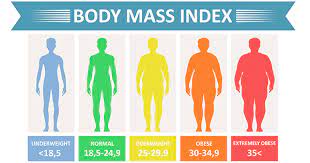
Credit: Getty Images/iStockphoto
It is important to note that BMI only index the overall mass an individual has and does not directly translate to the percentage makeup of that person (It does not account for % fat, muscle mass, water mass etc). The BMI of an athlete may be high but no direct correlation between this value and bad health
This brings me to arguably the most important metric of the three.
BFP
BFP can be summarized as the percentage of the body that constitutes fat. Fat is the body’s reserve store for energy. The composition of body fat may be classified as essential body fat and storage body fat. Essential fat is what is needed for a healthy life. It is the base body fat. Storage fat is found in adipose tissue and too much of it is harmful. Fat secretes its own hormones. As elaborated in the previous article on hormones influence on weight, fat produces leptin-the satiety hormone. Excess body fat may lead to obesity, a condition that predisposes individuals to many other detrimental health conditions like type II diabetes mellitus as obesity causes insulin resistance, hypertension, poor mental health outcomes, stroke and certain cancers.
Here's how to calculate body fat percentage;
The BMI Method;
Body fat percentage (BFP) formula for adult males:
BFP = 1.20 × BMI + 0.23 × Age - 16.2
Body fat percentage (BFP) formula for adult females:
BFP = 1.20 × BMI + 0.23 × Age - 5.4
Body fat percentage (BFP) formula for boys:
BFP = 1.51 × BMI - 0.70 × Age - 2.2
Body fat percentage (BFP) formula for girls:
BFP = 1.51 × BMI - 0.70 × Age + 1.4
The American Council on Exercise Body Fat Categorization
Description
Women
Men
Essential fat
10-13%
2-5%
Athletes
14-20%
6-13%
Fitness
21-24%
14-17%
Average
25-31%
18-24%
Obese
32+%
25+%


Comments (0)